As parents, one of the most significant gifts we can offer our children is the opportunity to establish their roots in a place they can call their own.
However, becoming a homeowner can seem like an unreachable goal for many young adults due to rising housing costs and strict mortgage requirements.
Fortunately, there’s a strategy that you can use to support your children’s journey to homeownership: a tax-free gift for a house deposit.
How much can I gift tax-free?
The annual Small Gift Exemption allows you to gift up to €3,000 per calendar year without having to pay Capital Acquisition Tax (CAT).
This doesn’t have to be in a single transaction; you can, for example, give 10 payments of €300.
If a gift goes beyond the annual limit of €3,000 per disponer, only the extra amount is considered for calculating Capital Acquisition Tax (CAT).
This rule for small gifts only applies to gifts and doesn’t include inheritance tax.
Note that gifts eligible for the Small Gift Exemption do not reduce the lifetime tax-free threshold, which is currently €400,000 from parent to child.
Who is eligible to give or receive the gift?
Although it’s common for parents to use this exemption to gift money to their children or grandchildren, gifts can come from anyone.
And the giver doesn’t have to be related to the recipient to qualify for the tax exemption.
How can you maximise the benefits of the small gift exemption?
Your children can receive gifts from several people in a calendar year, and the initial €3,000 from each giver is free from Capital Acquisition Tax (CAT).
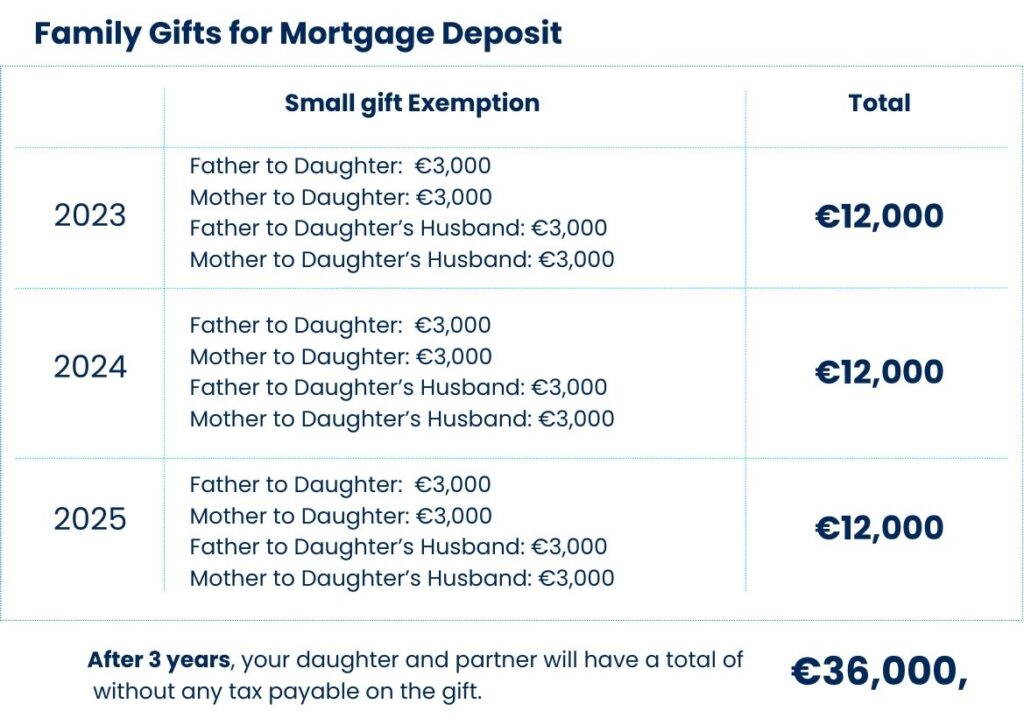
So, theoretically, each parent could give €3,000 to both their child and their child’s partner, totalling €12,000, without incurring any tax liabilities.
Let’s consider this example:
If you want to gift your daughter and husband money to help with the deposit for a house, you can use the small gift exemption over several years, as demonstrated below: