
How Can an Occupational Pension Scheme Benefit Employers and Employees?

Benefits If You’re An Employee
Retirement Security
If you’re an employee, occupational pension schemes can help you build a financial cushion for retirement, ensuring you have income after you stop working.
Read more about retirement planning and pensions in our article Retirement Planning in Ireland: Your Comprehensive Guide.
Employer Contributions
You can increase your retirement savings without having to make additional contributions out of pocket when your employer matches contributions to your pension plan.
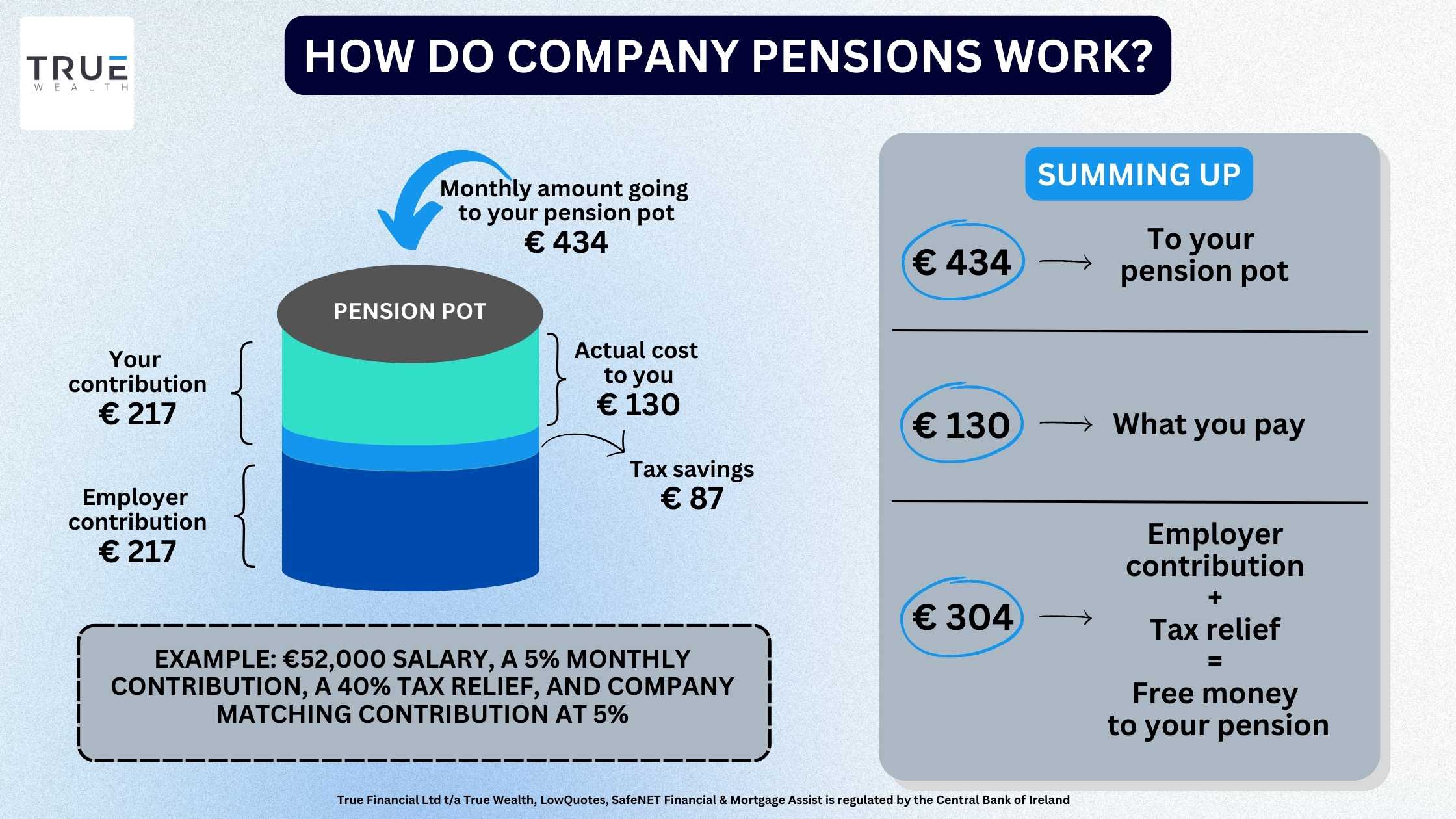
For example, if you earn €52,000 annually and contribute 5% to your company pension plan, with your employer matching your contribution, both of you would contribute €217 monthly.
Considering tax relief, your effective cost drops to just €130, allowing you to save more for retirement while paying less.
This essentially means you’re receiving an extra €304 towards your pension pot, effectively free money!
Tax Efficiency
The tax efficiency of company pensions allows you to save for retirement with potentially lower tax liabilities, making them an attractive option for long-term financial planning.
Investment Opportunities
Occupational pension schemes often provide a range of investment options, allowing you to tailor your retirement savings strategy to your risk tolerance and financial goals.
Learn more about retirement planning and pensions by reading our Retirement Guide.
Get a Retirement Planning and Pensions Quote with True Wealth
Whether you’re an employer seeking to establish a pension scheme for your staff or an employee eager to grasp the intricacies of an occupational pension plan, our team is here to provide expert advice.
Reach out to one of our financial advisors at True Wealth for any assistance or enquiries you may have regarding pension schemes.
Additionally, gain valuable insights by exploring our Retirement Planning Guide, offering comprehensive knowledge to help you navigate the intricacies of retirement planning and pensions.
We are also experts in personal and business protection, savings and investments, pension tracing, personal and business financial planning, mortgages, and wealth management and extraction.