
What Are the Differences Between a State Pension and a Private Pension?

Home | Retirement Planning | What Are the Differences Between a State Pension and a Private Pension?

Table of Contents

When discussing pensions, the State Pension can be the first that springs to mind, while a private pension might seem too complex or expensive. Understanding how pensions work is essential to retirement planning

If you’re reading this article, you’ve already taken the first step towards a financially stable retirement. 

There are various pension options available in Ireland, each with its own set of regulations, and we are here to help and guide you.

What is a State Pension?

A State Pension in Ireland is a weekly payment provided by the government if you have reached the age of 66 and have enough social insurance PRSI contributions. 

The State Pension (Contributory) isn’t means-tested, so you can receive it even if you have additional income, like an occupational pension.

The full State Pension rate is set at €277.30 per week as of January 2024. This means roughly €14,400 per year or €39.50 per day.

What Is a Private Pension?

A private pension, or personal pension, allows you more control and flexibility over your retirement. 

These pensions are funded through contributions from your income, with the possibility of additional contributions from your employer if you are in an Occupational Pension Scheme.

Main types of private pensions in Ireland:

Occupational Pensions: These are provided by employers and can be either defined benefit (DB) schemes, which promise a specific payout upon retirement, or defined contribution (DC) schemes, where the payout depends on the amount contributed and the performance of the investments. Learn more about Occupational Pension Scheme.

Personal Retirement Savings Accounts (PRSAs): These are individual pension plans that are flexible and portable, allowing you to continue contributing even if you change jobs. Learn more about PRSAs.

Personal Retirement Bond (PRB): allows you to invest the value of your pension fund into a bond when you leave a pension scheme. You will receive a Leaving Service Options Form from your old employer’s Occupational Pension scheme outlining your options.  This bond will then provide you with benefits upon retirement. Learn more about PRBs.

Additional Voluntary Contributions (AVCs): These are extra contributions you can make alongside your existing pension plan to boost your pension fund. Before deciding on an AVC, it is important to first understand what you will be entitled to when you retire. Learn more about AVCs.

Executive Pension: An executive pension is a retirement plan tailored for business owners and directors. This option allows both you and your employer to make tax-free contributions. Additionally, you may be eligible to take a tax-free cash lump sum, depending on your length of service, salary, and fund size. Learn more on how to protect, extract, and growing your wealth.

Important: Executive pensions are being formally phased out under new regulations, with a final compliance deadline set for April 2026.

Fortunately, you won’t lose your pension benefits; you can simply move your plan into a compliant structure such as a PRSA (Personal Retirement Savings Account) or a Master Trust.

Get a Retirement and Pension Planning Quote

Why Should I Have a Private Pension When There’s a State Pension?

The state pension in Ireland is a valuable source of income for retirees. However, it might not be enough to maintain the lifestyle you desire during retirement. 

With the state pension currently at €277.30 per week (as of January 2024), it’s crucial to consider the bills and expenses you’ll likely face and assess if this amount will be adequate for your financial well-being. If the answer is no, a private pension becomes an essential financial tool for securing your future.

A private pension can provide an additional income stream to cover living expenses, healthcare, mortgages, children’s education and leisure activities. 

Relying solely on the state pension might not be enough to sustain you, making it important to have another pension arrangement in place to support you when you retire. 

Discover more by reading our article on the benefits of having a private pension.

people are living longer

How do pensions work?

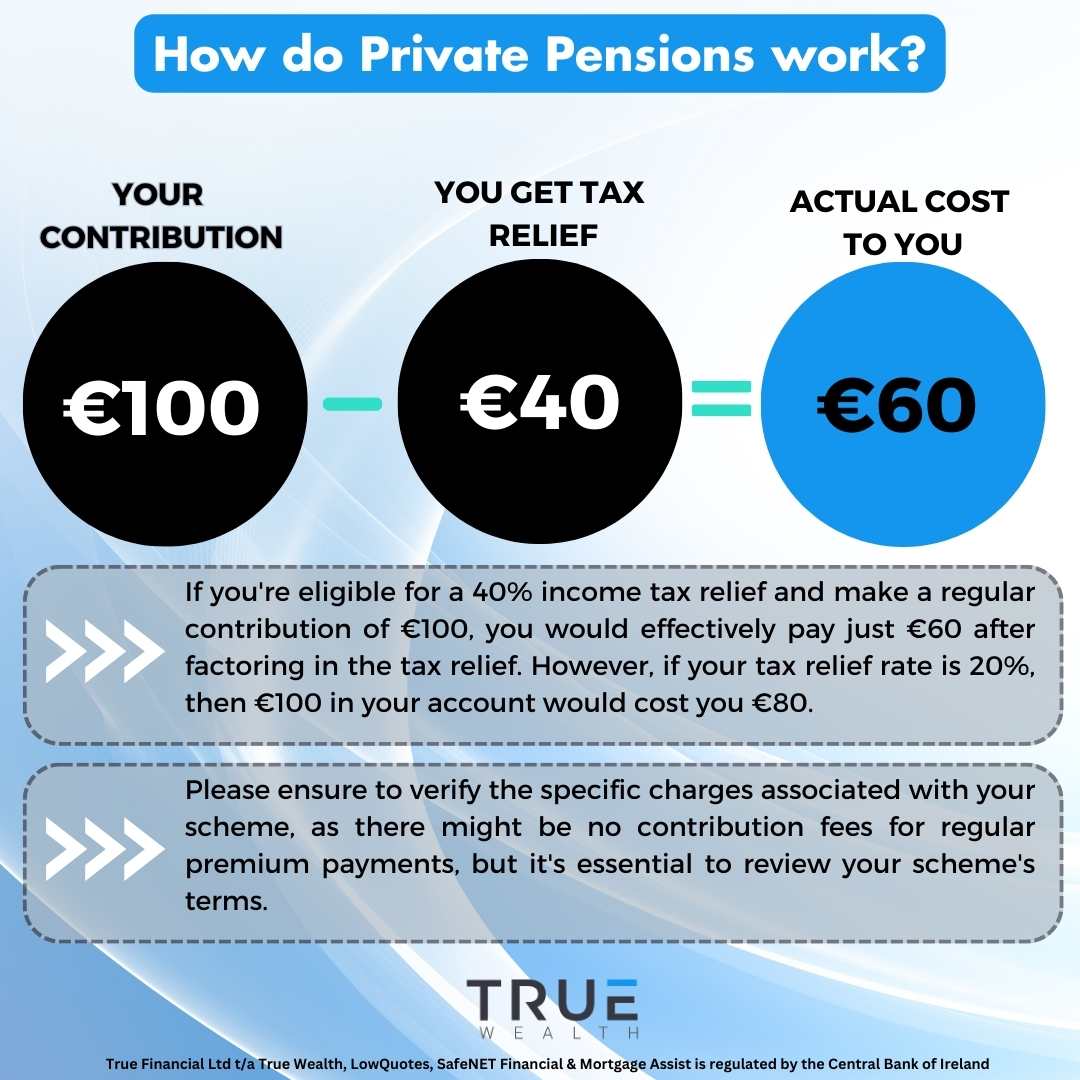
When you contribute to your private pension, the government provides tax relief, which means your contributions are deducted from your taxable income. The level of tax relief depends on your income and tax rate. 

For example, if you’re in the higher tax bracket and contribute €1,000, you may receive €400 in tax relief, reducing your effective cost to €600. This tax relief can significantly enhance your retirement savings over time.
How do private pensions work? - True Wealth

Additionally, a private pension offers flexibility in investment choices, allowing you to tailor your plan to your financial goals and risk tolerance. Explore our retirement guide for more information.


 

The ultimate Retirement Planning Guide.​

Planning for retirement is a significant life milestone. Whether you’re just starting to think about retirement or are already well into your retirement journey, this guide aims to empower you to make informed decisions and create a retirement plan that aligns with your unique financial goals and expectations.

After you download your guide, one of our expert mortgage advisors will be in touch shortly to provide you with guidance and further relevant information including typical repayments, qualification amounts and mortgage requirements.


Name(Required)
This field is for validation purposes and should be left unchanged.

Get a Retirement and Pension Planning Quote

Will My Private Pension Affect My State Pension?

No, your private pension will not affect your State Pension. You can receive the State Pension even if you have other income, such as an occupational pension.

When is the Best Time to Start a Private Pension?

The best time to start a private pension is now. Delaying can significantly impact your retirement savings. Starting early allows your investments to grow, potentially providing a more substantial pension fund. 

The power of compound interest and time makes today the best moment to secure your financial future. 

How Can I Know If My Pension Funds Will Be Enough for Retirement?

To determine if your pension funds will be sufficient for retirement, you might consider the following steps:

Estimate Your Retirement Expenses: Calculate your anticipated living costs, including mortgage, food, healthcare, leisure activities, and any other regular expenses.

Evaluate Your Current Savings: Assess the total amount you have saved in your pension fund and other retirement accounts.

Calculate Your Expected Income: Include your state pension, private pension, and any other sources of retirement income.

Consult a Financial Advisor: Speak with one of our financial advisors to help you create a detailed retirement plan and make necessary adjustments to your savings strategy.

By carefully planning and regularly reviewing your finances, you can better ensure your pension funds will meet your retirement needs.

Learn more by reading our article on this topic.

What Happens To Your Pension Plan When You Die?

The outcome of your pension plan depends on whether you die before or after retiring and the type of pension you have.

You can read more about what happens to your pension when you die in our article, where we also cover inheritance tax. 

Understanding these details helps you make informed decisions for you and your loved ones’ future, ensuring that you are prepared for all eventualities and can maximize the benefits for your beneficiaries.

What Happens To Your Pension After Leaving Your Job?

When you leave your job, the options for your pension depend on how long you’ve been part of the company’s pension plan. You can transfer your pension to your new employer’s scheme, leave it with your former employer, or move it to a personal retirement account. Each choice has implications based on the duration of your membership in the pension scheme.

Learn more by reading our article.

Articles you might find useful:

Get a Retirement Planning and Pensions Quote with True Wealth

Securing your financial future is paramount, and True Wealth is here to assist you every step of the way. 

We understand that retirement planning is not one-size-fits-all. We work closely with you to develop a personalised strategy that aligns with your unique financial situation, lifestyle, and retirement goals. 

With our expertise, you can navigate the complexities of retirement planning in Ireland, make informed financial decisions, and secure a comfortable retirement that aligns with your dreams and expectations. 

Don’t limit your retirement to the State pension; partner with True Wealth for a well-structured and tailored retirement plan

We provide various financial services, such as mortgages, serious illness cover, pensions, life insurance, financial planning, health insurance, and savings & investments

Get a Retirement and Pension Planning Quote

All our content has been written or overseen by a qualified financial advisor. However, you should always seek individual financial advice for your unique circumstances.

Warning: Past performance is not a reliable guide to future performance.      

Warning: The value of your investment may go down and up.      

Warning: If you invest in this product, you will not have any access to your money until you retire.   

Warning: If you invest in this product, you may lose some or all of your investment.     

Warning: This product may be affected by changes in currency exchange rates.